MercoPress. South Atlantic News Agency
Environment
-
Thursday, November 5th 2026 - 07:14 UTC
One dead and more than 2,000 affected by El Niño flooding in the Galápagos
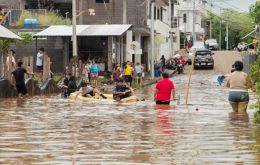
Heavy rains linked to the El Niño phenomenon triggered a flash flood on Santa Cruz island in Ecuador’s Galápagos archipelago overnight from Friday to Saturday, leaving one person dead and more than 2,000 affected, according to local mayor Fanny Uribe. Water reached up to three metres deep in some neighbourhoods of Puerto Ayora, the island’s main town.
Add your comment! -
Thursday, November 5th 2026 - 07:00 UTC
Peru declares an El Niño emergency in nearly three-quarters of the country ahead of the Pope’s visit
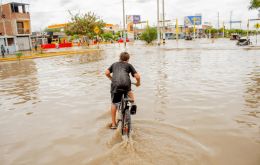
Peru’s government has declared a two-month state of emergency over the risk of heavy rains linked to the El Niño phenomenon in 1,380 of the country’s 1,891 districts, about 73%, including all the places Pope Leo XIV will visit in northern Peru from November 13. The measure covers districts in all 24 departments and the province of Callao.
Add your comment! -
Wednesday, October 28th 2026 - 15:10 UTC
Falklands approves bill on oil pollution emergencies in relation to offshore installations, and responsibilities
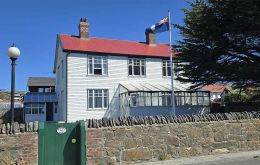
The Falkland Islands Executive Council has approved a set of Regulations 2026 to amend the Maritime (Oil Pollution Preparedness, Response and Co-operation Convention) Regulations 2019 (“the OPRC Regulations”) to make provision for the preparation and maintenance of oil pollution emergency plans in relation to offshore installations and to require the persons responsible for offshore installations to report oil incidents where oil is discharged into the sea.
-
Wednesday, October 21st 2026 - 14:44 UTC
An unusual die-off of southern right whales in Argentine Patagonia alarms scientists
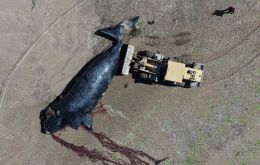
Scientists monitoring the southern right whale population at Península Valdés, in Argentina’s Chubut province, have recorded since July an unusual number of deaths among calves and adults which, they expect, could make this the worst year on record. They are investigating the role of a bacterium and of a toxic algal bloom known as “red tide”.
-
Wednesday, October 21st 2026 - 13:29 UTC
Amazon fires rise 62% in October as deforestation falls to a record low
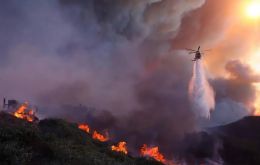
Satellites detected 9,045 fire hotspots in the Brazilian Amazon in the first half of October, 62% more than in the same period last year, amid a drought aggravated by El Niño. The increase contrasts with the fall in deforestation, which over the past year reached its lowest level since 1988.
-
Wednesday, October 21st 2026 - 13:01 UTC
The area of Antarctic ozone hole during September reached 15 million km2, says Copernicus

The Copernicus Atmosphere Monitoring Service (CAMS) (*) has found that the 2026 Antarctic ozone hole reached a significant size threshold slightly earlier than average, aligned with 2025. It has also stayed ahead of average, unlike the previous year.
-
Wednesday, October 14th 2026 - 07:01 UTC
A tornado and an unusual spring hailstorm overwhelm Santiago, Chile
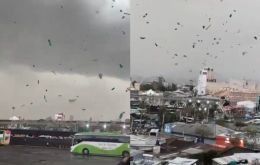
An electrical storm with hail, unusual in the middle of spring, flooded streets, homes and businesses in Santiago, Chile, on Tuesday and produced a tornado that the Chilean Meteorological Directorate preliminarily classified as EF0, the lowest intensity category. The national disaster prevention and response service declared a red alert in the Metropolitan Region, five days after the mudslide that hit the Las Condes district.
-
Tuesday, October 13th 2026 - 06:29 UTC
Brazil blames human action for the fires sweeping the Amazon
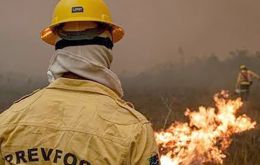
The Brazilian government has blamed deliberate human action for the wave of fires in Amazonas state, where 540 new hotspots were recorded in 48 hours, more than half of those detected in the whole of October 2025, according to the National Institute for Space Research. The situation has led to a state of emergency in 36 municipalities.
-
Monday, October 12th 2026 - 22:09 UTC
Iguazú Falls closed as the river’s flow tops 12,000 cubic metres per second
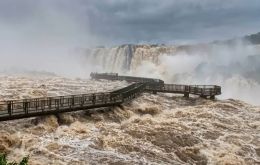
Iguazú National Park, in Argentina’s Misiones province, closed access to the falls’ walkways on Monday because of an exceptional rise in the Iguazú River, whose flow exceeded 12,000 cubic metres per second. The flood is part of an episode of heavy rainfall linked to El Niño that has also caused the Uruguay River to burst its banks, with evacuations on both sides.
-
Monday, October 12th 2026 - 07:04 UTC
BAS researchers uncover chinstrap penguins massive colony decline in Antarctic volcanic island

A remote volcanic island near Antarctica has lost its title of largest penguin colony in the world, as new research reveals massive population declines, igniting fears for species’ survival. Researchers from British Antarctic Survey (BAS) have uncovered the loss of over half a million chinstrap penguins from the Antarctic island of Zavodovski in the South Sandwich Islands.

